Key takeaways
- Research Arabic keywords from real search results, Google autocomplete in Oman and Search Console. Don't just translate your English keyword list, and don't take keyword-tool volumes at face value.
- Write page bodies in Modern Standard Arabic, and put the words your market really searches for (dialect terms included) in titles, headings, product names and FAQs. Then check the results in Search Console.
- Use one 'ar' version plus 'en' unless the content truly differs by country. Every page should list itself and its alternates with full https URLs, and include an x-default.
- Arabic-script and transliterated slugs both work in Google. Pick one for practical reasons, such as sharing, analytics readability and your CMS, and use it consistently.
- Measure Arabic pages on their own in Search Console (impressions, clicks, queries, country = Oman). Nobody can honestly guarantee rankings or timelines.
On this page
Is Arabic SEO different from English SEO?
In principle, no. In practice, yes. Google uses the same systems for both languages: it wants helpful, people-first content, crawlable URLs and correct signals about which page serves which language. The work around those principles is different in Arabic:
- Keywords. One idea can be typed in several dialects, spellings and scripts.
- Language register. You have to choose between Modern Standard Arabic (MSA) and dialect, and decide where each one goes.
- URLs and hreflang. Arabic-script slugs and paired ar/en pages add technical decisions that English-only sites never have to make.
- Content quality. Translated pages often read as thin to Arabic speakers, and Google's helpfulness standards apply to them like any other page.
The opportunity in Oman is real. DataReportal estimated 5.28 million internet users in Oman in October 2025, a 95.3% penetration rate, with 6.93 million cellular mobile connections (125% of the population). Both Arabic and English are used in search here, so most business sites need to work properly in both languages.
How to do Arabic keyword research
Start from what people actually type. Your English keyword list is the wrong starting point. Translating "web design company Muscat" word for word gives you a phrase that may be grammatically correct while few people search it that way.
A workflow that works:
- List the topics, not the keywords. Write down the services, products and questions your page should answer.
- Brainstorm with native speakers from your market. Ask an Omani colleague how they would search for the service. Don't ask how to translate it.
- Use Google autocomplete from Oman. Type the start of each phrase in Arabic and note the suggestions. Repeat with spelling variants (see below).
- Read the results page. Search each candidate phrase and check what ranks. Are the results Arabic or English? Informational articles or service pages? Gulf sites or Egyptian ones? This tells you what Google thinks the searcher wants.
- Treat tool volumes as a hint. Practitioners report that keyword tools can underreport Arabic volumes, so check against the live results before you drop a phrase as "zero volume".
- After launch, mine Search Console. The queries report shows the real Arabic words that bring impressions. It's your best source for the next round of content.
Should you write in dialect or Modern Standard Arabic?
Write the body of most pages in MSA. Use the words your market actually searches for in the places that carry the most SEO weight. Google publishes no guidance on dialect versus MSA, so treat this as a working hypothesis and test it.
The common practitioner approach is to keep page bodies in MSA while using market-specific words, dialect included, in titles, headings, product names and FAQs. The classic example is shoes: Egyptian users often search جزمة, while Saudi users search حذاء. A store that serves only one of those markets should use that market's word where it matters.
Some rough guidance:
- Informational, evergreen and technical pages (guides, documentation, policies) tend to suit MSA.
- Product and category names, FAQs and ad-style headings should follow local search words, even when the rest of the page is MSA.
- The GCC is not North Africa. Practitioners note that search behaviour differs between Gulf and North African users. Don't copy an Arabic keyword list built for Cairo or Casablanca into a Muscat site.
The test-and-measure part: if you're unsure between two terms, put the dominant one in the title and H1 and the other in the body or FAQ. After a few months, check in Search Console which one earns impressions and clicks.
Spelling variants, mixed queries and Arabizi
Arabic users spell the same word in several ways, and many mix Arabic with English. Your research and copy should reflect both habits.
Spelling variants to check for each important keyword:
- Hamza forms: أ / إ / ا (people often type plain ا)
- Taa marbuta vs haa: ة / ه
- Alif maqsura vs yaa: ى / ي
- Singular vs plural: تصميم موقع vs تصميم مواقع
Don't stuff every variant into one page. Use the main form in titles and headings, and let the others appear naturally in the body and FAQs. Check the results page for each variant, because the results can differ.
Mixed-script queries are very common for brands, products and tech terms. One example from practitioners is "سعر iPhone 17". If your customers type the brand name in Latin letters, use it that way in your Arabic titles. Don't force a transliteration nobody uses.
Arabizi is Arabic written in Latin letters and numbers (for example, "7" standing in for ح). It shows up in social media and some searches. Check whether it appears in your Search Console queries before you spend effort on it. For most business sites it's an FAQ consideration at most, not a content strategy.
Should Arabic URL slugs use Arabic script or transliteration?
Both work. Choose based on practicalities, not rankings. Google's John Mueller has said that non-English words in URLs are fine, and recommended for non-English sites. This is an older statement, but it hasn't been contradicted. Google's own URL documentation uses an Arabic-script URL as its example and notes that non-ASCII characters should be percent-encoded in href attributes.
We haven't seen verified evidence that one style ranks better than the other. Practitioners describe the choice as an architectural decision, and the trade-offs look like this:
| Option | Example | Pros | Cons |
|---|---|---|---|
| Arabic-script slug | /ar/تصميم-مواقع/ | Readable for Arabic users, matches the query | Copy-pasting often turns it into a long %D8%... string. Harder to read in some analytics and log tools |
| Transliterated slug | /ar/tasmeem-mawaqe/ | Clean when shared, ASCII-safe | Inconsistent spellings, and meaningless to many readers |
| English slug on Arabic page | /ar/web-design/ | Mirrors the English URL, so hreflang pairs are easy to manage | Not descriptive for Arabic users |
Whichever you choose, keep slugs short, use hyphens, keep them consistent across the site and never change them after launch without 301 redirects. Google also warns that complex URLs with many parameters can cause crawling problems and duplicate-URL bloat. Filters on Arabic e-commerce category pages are a common culprit.
How to set up hreflang for Arabic and English
Hreflang tells Google which language version to show each user. For a bilingual Omani site, the setup is usually simple. Get these rules right, all from Google's localized versions guide:
- Every version lists itself and all alternates. If the Arabic and English pages don't point to each other, the tags may be ignored.
- Use fully qualified URLs including https, not relative paths like /ar/services/.
- Use valid codes: a language code in ISO 639-1 (ar, en), optionally followed by a region in ISO 3166-1 Alpha 2 (ar-OM, ar-AE, ar-SA). Made-up codes such as ar-GCC or ar-KSA aren't supported.
- Add x-default as the fallback for unmatched languages, for example a language selector or auto-redirecting home page.
- Pick one method: link tags in the head, HTTP headers or the XML sitemap. Alternate URLs don't have to be on the same domain.
A typical service page, in the head of both the Arabic and English versions:
<link rel="alternate" hreflang="ar" href="https://example.com/ar/services/" />
<link rel="alternate" hreflang="en" href="https://example.com/en/services/" />
<link rel="alternate" hreflang="x-default" href="https://example.com/en/services/" />
Do you need ar-OM, ar-AE and ar-SA?
Usually not. Use country codes only when the content really differs: prices in OMR vs AED vs SAR, different shipping, different regulations. Otherwise a single ar version plus en is simpler and less error-prone. If you do create country variants, Google suggests keeping a generic catch-all page for the language, so a plain ar page remains a sensible fallback for Arabic users elsewhere in the GCC.
Common hreflang mistakes
- Arabic page points to English, but English doesn't point back
- Relative URLs, or http URLs on an https site
- Hreflang pointing to redirected, noindexed or canonicalised-away URLs
- A canonical on the Arabic page that points to the English page, which tells Google the Arabic page isn't the main version
- Pairing an Arabic page with an unrelated English page, such as the home page
Site structure: subdirectories, domains and language switchers
For most Omani businesses, one domain with language subdirectories (/ar/ and /en/) is the simplest, strongest setup. Google recommends language- or country-specific URLs such as a subdirectory or a ccTLD. What it advises against is serving both languages on the same URL via cookies or scripts.
- Subdirectories (/ar/, /en/): one domain to build authority, one Search Console property, easy hreflang.
- Separate ccTLDs: worth it only when you run genuinely separate country businesses.
- Language switcher: link each page to its exact counterpart, not the other language's home page. Don't force-redirect users by browser language or IP without letting them switch back.
- Sitemaps: include both language versions. If you implement hreflang in the sitemap, keep it in sync with the CMS so new pages get paired automatically.
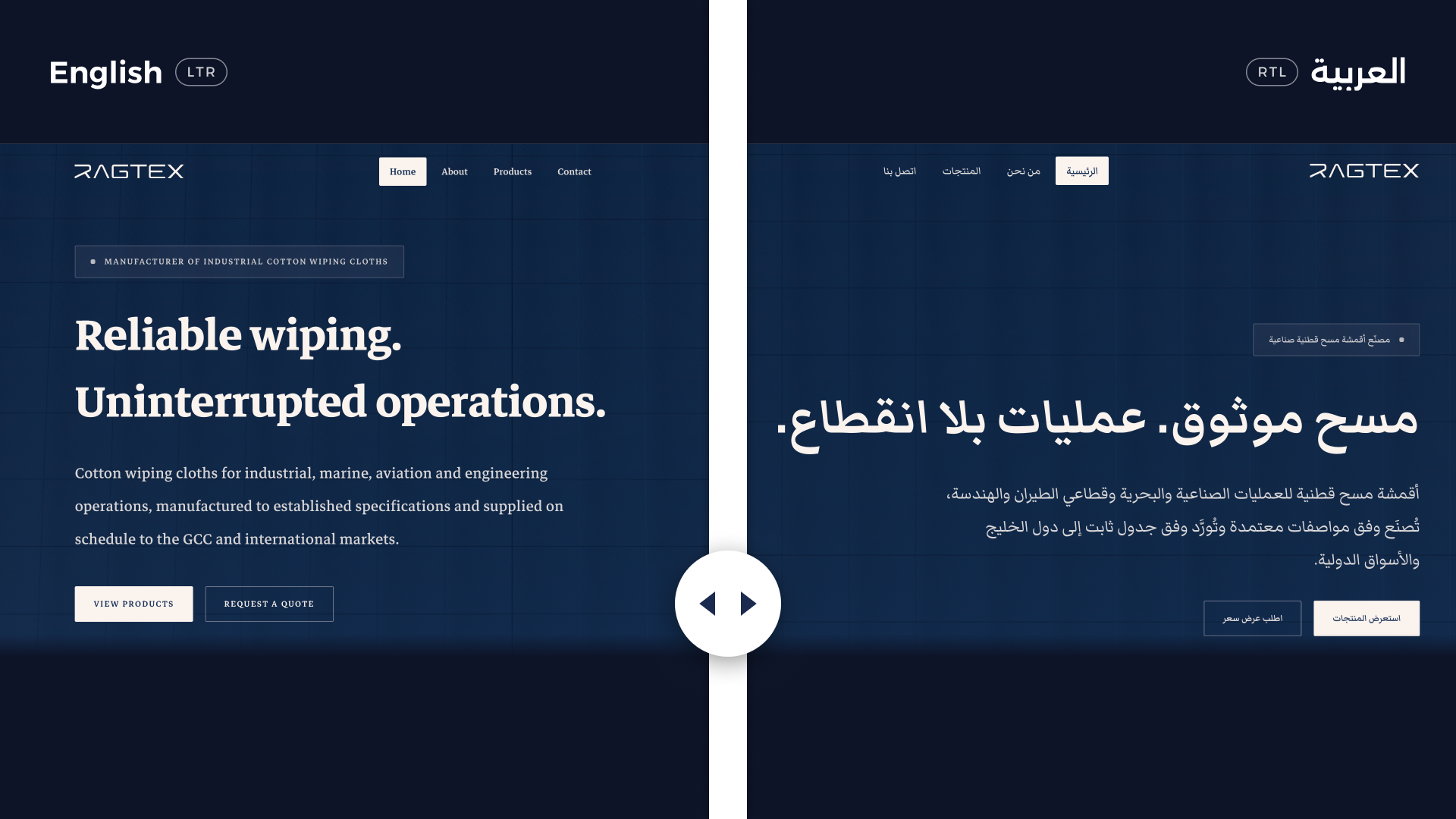
For the layout side (RTL mirroring, fonts, forms, numerals), see our bilingual Arabic–English website checklist.
How deep does Arabic content need to be to rank?
As deep as it needs to be to fully answer the searcher's question in Arabic. That's often deeper than a translated English page. Google asks for helpful, reliable, people-first content and publishes self-assessment questions. Run your Arabic pages through them separately from the English ones.
Practitioners say treating Arabic SEO as translation instead of native content is a common failure. In practice:
- Localise examples. Use Omani prices in OMR, local delivery areas, Ministry or municipality steps and Gulf references. Generic examples don't help a Muscat reader.
- Answer the questions Arabic searchers ask. Your Arabic FAQs may need different questions from the English ones.
- Have a native editor review everything. Thin, unreviewed machine translation is risky, both for rankings and for trust.
- Don't publish half-empty Arabic pages just to have a matching URL. A smaller set of strong Arabic pages beats a full mirror of weak ones.
Technical checks for Arabic pages
Before launch, check these on the Arabic version specifically:
- The html lang attribute is set to ar and dir to rtl on Arabic pages
- Unique Arabic title tags and meta descriptions, not English text or blanks
- Structured data (Organization, Product, FAQ, Breadcrumb) filled in with Arabic text on Arabic pages
- Arabic image alt text
- Correct canonicals: each Arabic page canonicalises to itself
- URL Inspection in Search Console confirms Arabic pages are indexed and render correctly
- Mobile performance: with mobile connections at 125% of Oman's population, most Arabic visitors will arrive on a phone
How to measure Arabic SEO progress
Measure the Arabic pages separately, and watch trends rather than single rankings. In Search Console:
- Filter Pages by URLs containing /ar/.
- Add a Country filter for Oman (and other GCC markets you serve).
- Track impressions first (are you being seen?), then clicks and CTR (are titles compelling?), then average position for priority queries.
- Review the Queries report monthly for new Arabic phrases and spelling variants to write about.
- Connect organic Arabic traffic to leads or sales in your analytics, so SEO is judged on business results.
No one can promise a position or a timeline in Google. Anyone who does is guessing. Work out what your website budget looks like and plan for ongoing Arabic content, not a one-off launch.
Arabic SEO launch checklist
- Arabic keyword list built from autocomplete, live results and native speakers, not translation
- Dialect vs MSA decision made per page type, with local terms in titles, H1s and FAQs
- Spelling variants and mixed-script queries checked for priority keywords
- Slug style chosen (Arabic, transliterated or English) and applied consistently
- /ar/ and /en/ subdirectories with a page-to-page language switcher
- Hreflang reciprocal and self-referencing, with absolute https URLs, valid codes and x-default
- Country codes (ar-OM, etc.) used only where content truly differs
- Arabic titles, meta descriptions, alt text and structured data in place
- Native-speaker review of all Arabic content
- Search Console set up, sitemap submitted, Arabic pages checked with URL Inspection
How AbuData can help
Every site AbuData builds is bilingual from day one, with a CMS so your team can publish and refine Arabic content without waiting on developers. Since 2021 we've delivered 40+ projects for 32+ clients across Oman and the GCC, and we also build our own Arabic-first, right-to-left products, such as Jawab. If you're planning an Arabic or bilingual site and want the search foundations right from the start, see our services or get in touch.
Frequently asked questions
Can I just machine-translate my English site into Arabic for SEO?
It's risky. Thin, unreviewed machine translation tends to produce Arabic that reads awkwardly and misses the words people actually search for. Google's standard is helpful, people-first content. Use translation as a first draft at most, and have a native Arabic editor localise it.
Should my Arabic pages target Oman only or the whole GCC?
If your prices, shipping and rules are the same everywhere, one generic 'ar' version serves Arabic users across the GCC with less maintenance. Create ar-OM, ar-AE or ar-SA versions only when the content really differs, such as currency or regulations. Even then, keep a generic 'ar' fallback.
Do Arabic URLs hurt SEO?
No. Google has said non-English words in URLs are fine for non-English sites, and its own documentation uses an Arabic-script URL as an example. The real trade-offs are practical: Arabic slugs become long percent-encoded strings when copy-pasted and can be harder to read in some analytics tools.
What hreflang code should I use for Arabic in Oman?
Use 'ar' for a general Arabic version, or 'ar-OM' if the page is specifically for Oman. Codes must follow ISO 639-1 for language and ISO 3166-1 Alpha 2 for region. Made-up codes like 'ar-GCC' or 'ar-KSA' aren't supported.
How long does Arabic SEO take to show results?
No one can honestly guarantee a timeline or a ranking. Watch Search Console for growing impressions on your Arabic pages first, then clicks and positions for your priority queries. Results depend on competition, content quality and how consistently you publish.
Do I need separate Arabic keywords for Saudi Arabia, the UAE and Oman?
Often yes for product names and everyday terms, because Gulf users don't all use the same words, and Gulf usage differs from Egyptian or North African usage. Check autocomplete and the live results for each market you target. Let Search Console show which terms actually bring impressions from each country.
Sources
- Localized Versions of your Pages (Google Search Central)
- URL structure best practices for Google Search (Google Search Central)
- Google Says It's Fine To Use Non-English URLs For Non-English Pages (Search Engine Roundtable)
- Digital 2026: Oman — DataReportal
- Creating helpful, reliable, people-first content (Google Search Central)
- SEO in Arabic: A Practical Guide for Arabic Websites
- Arabic SEO in the UAE: 2026 Technical Guide
- Arabic SEO in 2025: Why Most Brands Are Still Getting It Wrong